
Contributor hubCategory
Research
Research and analysis


Best of Both Worlds? A Measured Review of Non-Interactive ZK Fraud Proofs
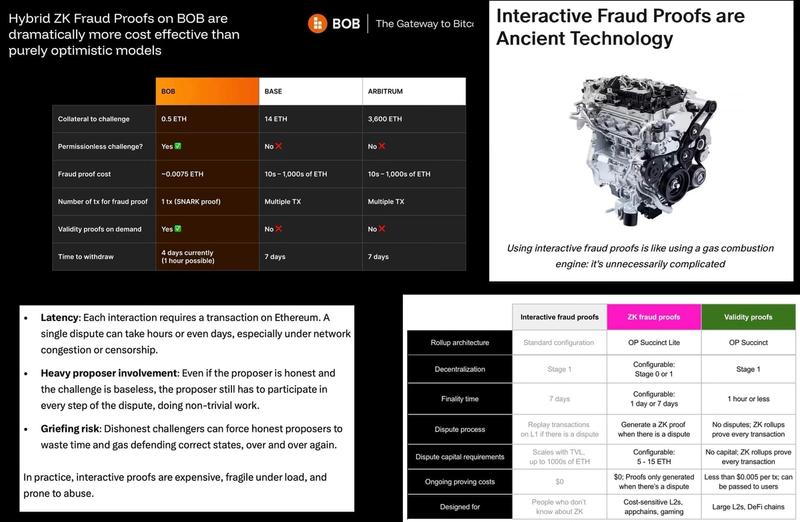
Recent advances in Non-Interactive (NI) ZK Fraud Proofs, like Kailua and OP Succinct Lite, promise faster withdrawals and lower costs for optimistic rollups. We rigorously steel-manned NI designs against a strong threat model and compared them to Interactive Fraud Proofs (like Dave) and ZK Validity Proofs. Our analysis finds that current NI systems are vulnerable to Sybil attacks, coordination failures, and resource exhaustion, preventing true 1-of-N liveness and undermining decentralization. While NI may hold promise, they do not currently deliver the “best of both worlds,” and Interactive Fraud Proofs remain more resilient and cost-effective under adversarial conditions.


PRT FRAUD PROOF FOR NON-MATHEMATICIANS
The need to scale programmable blockchains has created a strong demand for secure ways to offload computations outside the blockchain. One of the most popular options today is called rollups. Rollups involve off-chain nodes executing these offloaded computations, then proving the results back to the base layer. This is a good approach to solving the scalability issue, as these off-chain computers are not constrained by the limitations of the blockchain network. They, therefore, can be more specialised, faster and better equipped to handle complex transactions.



The Dave Fraud-Proof Algorithm
The Dave algorithm is a next-generation fraud-proof system that balances decentralization, security, and liveness. It allows anyone to participate, withstands Sybil attacks, and resolves disputes efficiently, proving that optimistic rollups can remain secure even against powerful adversaries.


Enforceable Human-Readable Transactions: how to solve Bybit-like hacks
The $1.5 billion Bybit hack exposed a flaw in Ethereum’s transaction signing: humans can’t read raw transaction data. This post proposes embedding human-readable descriptions in EIP-712 messages, letting users verify actions before signing. The approach improves security without protocol changes and works especially well on Layer 2s or Cartesi appchains.



Fraud Proofs Are Broken
Optimistic rollups aim to inherit Ethereum’s security through fraud proofs. The reasoning is straightforward: a single honest validator can prove all dishonest validators are liars, and thus enforce the truth. Since anyone can be a validator (including you), securing any optimistic rollup is just a matter of setting up a node to run on your laptop. No need to trust anyone.